
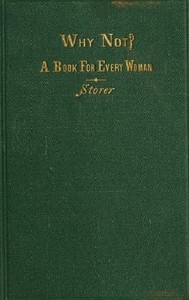
Why not? A book for every woman by Horatio Robinson Storer
Let's talk about a book that feels less like a quiet read and more like a heated conversation with history. 'Why Not? A Book for Every Woman' by Dr. Horatio Robinson Storer is a medical and moral manifesto from 1867. There's no traditional plot with characters; instead, the 'story' is Storer's passionate campaign. He was a prominent Boston surgeon and a key player in the 19th-century movement to criminalize abortion.
The Story
The book is his direct appeal. Storer argues that a woman's highest purpose is motherhood and that avoiding it through 'criminal' means (a term he uses for abortion and certain contraceptives) is a sin against God, her family, and the nation. He blends religious doctrine, shaky scientific theories of the era, and strong patriotic sentiment. He paints a picture of a country needing robust families and warns of the physical and moral dangers he believes await women who defy this natural role. The narrative is his relentless effort to persuade, scare, and shame his female readers into compliance.
Why You Should Read It
This isn't a book you read for agreement. You read it for understanding. It's a primary source, a direct line to the arguments that shaped laws and lives for generations. Reading Storer's absolute certainty is a stark reminder of how much has changed. It makes you appreciate the long, difficult fight for bodily autonomy. The value is in the context. It helps explain the deep historical roots of contemporary debates. It’s also a case study in how medicine and morality were inseparably linked in ways we'd find unacceptable today. It challenged me, angered me, and ultimately gave me a much deeper appreciation for the progress that has been made, however incomplete.
Final Verdict
This book is perfect for readers interested in the raw history of women's rights, medicine, or social policy. It's for anyone who wants to go beyond textbook summaries and hear the actual arguments from a key historical figure. It's not an easy or pleasant read, but it is a profoundly illuminating one. If you're looking for a neutral history book, this isn't it—this is the source material, passionate, biased, and utterly revealing of its time. Approach it with a critical mind, and you'll come away with a powerful new perspective.
You are viewing a work that belongs to the global public domain. Use this text in your own projects freely.
Elizabeth Moore
10 months agoI wanted to compare this perspective with traditional views, the practical checklists included are a great touch for real-world use. A solid investment for anyone's personal development.
Nancy Moore
2 months agoTo be perfectly clear, the author's voice is distinct and makes complex topics easy to digest. I learned so much from this.
Elizabeth Gonzalez
1 year agoVery helpful, thanks.
Lucas Scott
1 year agoThis is one of those stories where the narrative structure is incredibly compelling. A true masterpiece.





George Brown
1 year agoGreat value and very well written.