
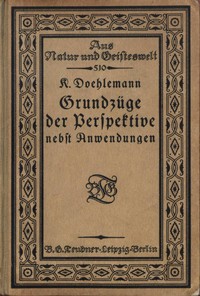
Grundzüge der Perspektive nebst Anwendungen by Karl Doehlemann
Let's be clear from the start: this is not a beach read. Karl Doehlemann's Grundzüge der Perspektive nebst Anwendungen (Fundamentals of Perspective with Applications) is a technical manual. Published in 1904, its goal is straightforward: to teach the mathematical and geometric rules for creating the illusion of depth on a flat surface.
The Story
There's no plot in the traditional sense. Instead, Doehlemann systematically builds a world of lines and vanishing points. He starts with the basics—how a single point defines a viewer's position. Then, he layers on complexity: one-point perspective for a hallway, two-point for a building corner, three-point for looking up at a skyscraper. He uses precise diagrams and methodical explanations to show how to correctly draw shadows, reflections, and complex shapes like spirals or arches. The 'applications' in the title are practical exercises, guiding the reader from theory to drawing real objects. The 'story' is the patient unveiling of a hidden structure that governs how we see everything.
Why You Should Read It
I picked this up out of sheer curiosity about old textbooks, and I was stunned by its elegance. In our age of 3D software, Doehlemann's work is a reminder of the profound intelligence in pre-digital craft. Reading it, you feel you're peering over the shoulder of a master teacher. There's a beautiful logic to it all. But what really got me was the historical context. This book is a snapshot of a specific moment in understanding. It represents the peak of a certain kind of orderly, Euclidean worldview—a world that could be measured, plotted, and controlled on paper. Holding that thought while knowing what the 20th century had in store adds a layer of poignancy you just don't get from a modern tutorial.
Final Verdict
This book is a niche treasure. It's perfect for artists, illustrators, or architects with a historical bent who want to understand the 'why' behind the rules they might use intuitively. It's also fascinating for history of science enthusiasts or anyone who loves old, beautifully made technical books. You'll need some patience and a fondness for geometry. But if you fall into those camps, reading Doehlemann is less like studying and more like having a conversation with a clear-minded guide from a vanished age. You come away not just knowing how to draw a box in perspective, but appreciating the fragile, beautiful framework we once used to make sense of our world.
This content is free to share and distribute. Distribute this work to help spread literacy.
Kenneth Robinson
2 months agoSurprisingly enough, it creates a vivid world that you simply do not want to leave. Exactly what I needed.
Mary Perez
10 months agoAfter hearing about this author multiple times, the content flows smoothly from one chapter to the next. Highly recommended.
Liam Scott
1 year agoThis is one of those stories where the flow of the text seems very fluid. A valuable addition to my collection.
Ashley Flores
1 year agoComprehensive and well-researched.





Patricia White
2 years agoThe clarity of the introduction set high expectations, and the author manages to bridge the gap between theory and practice effectively. A rare gem in a sea of mediocre content.