
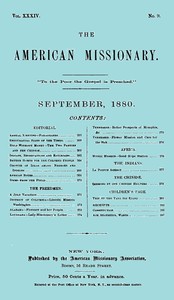
The American Missionary — Volume 34, No. 09, September, 1880 by Various
This isn't a book with a single plot. The American Missionary was a real monthly publication by the American Missionary Association. The September 1880 issue is a collection of letters, field reports, financial statements, and short articles written by the people on the ground—missionaries and teachers working primarily in the post-Civil War South.
The Story
Think of it as a blog or a newsletter from the front lines of Reconstruction. There's no main character, but a chorus of voices. A teacher in Georgia writes about her 60 students, all eager to learn but lacking basic supplies. A minister in South Carolina details the construction of a new church and school, listing every dollar spent on lumber and nails. There are sobering lists of donations (often just a few dollars from northern churches) right next to urgent appeals for more help. The 'story' is the day-to-day work of building a new future: fighting illiteracy, poverty, and deep-seated prejudice, one classroom and one sermon at a time. The tension comes from the gap between their monumental goals and their very limited means.
Why You Should Read It
I was blown away by the immediacy. History books summarize this era, but here you get the unedited emotion. The writers aren't crafting a narrative for posterity; they're asking for money, reporting progress, and worrying about the winter. Their faith and their frustration are right on the surface. You see the pivotal role of education as liberation, and the incredible courage of ordinary people—especially the many women educators—who moved across the country to do this work. It completely reshaped my understanding of Reconstruction, moving it from a chapter in a textbook to a human struggle with ink smudges and prayer requests.
Final Verdict
This is for the curious reader who loves primary sources. If you enjoy history podcasts, documentaries, or the feeling of discovering old letters in an attic, you'll be captivated. It's perfect for anyone interested in U.S. history, social justice, education, or religion. It's not a light read—the language is formal and of its time—but it's a short, powerful dose of reality. You won't get a neat story, but you will get something better: a genuine connection to the past.
This book is widely considered to be in the public domain. Feel free to use it for personal or commercial purposes.
George Thomas
10 months agoExtremely helpful for my current research project.
Jessica Lee
2 years agoI particularly value the technical accuracy maintained throughout.
David Jackson
1 year agoGiven the current trends in this field, the step-by-step breakdown of the methodology is extremely helpful for students. I feel much more confident in my knowledge after finishing this.
Patricia Garcia
11 months agoThe analytical framework presented is both innovative and robust.





William Moore
9 months agoSolid information without the usual fluff.