
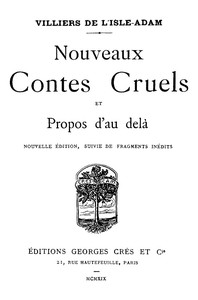
Nouveaux contes cruels et propos d'au delà by Villiers de L'Isle-Adam
Let's be clear: this isn't a single novel with a linear plot. Nouveaux contes cruels et propos d'au delà is a collection of short stories and philosophical fragments from the late 19th century. Villiers de L'Isle-Adam was a French symbolist writer, a peer of people like Baudelaire, and he had a bone to pick with the modern, industrializing world. His stories are his weapon.
The Story
There is no one story, but a series of vivid, often bizarre scenarios. In the most famous tale, 'The Eve of the Future Eden,' a disillusioned inventor creates an impossibly lifelike android named Hadaly to replace a flawed real woman. Another story, 'The Torture by Hope,' follows a prisoner of the Spanish Inquisition who is given a tantalizing, likely false, chance at escape. Others are brief, razor-sharp dialogues or monologues—'propos' from beyond—where characters debate love, death, and the emptiness of existence. The common thread is a setup that looks like it might lead to romance, triumph, or beauty, only to twist into something bleak, ironic, or tragically absurd.
Why You Should Read It
I love this book because it feels dangerous. Villiers doesn't want to just scare you; he wants to dismantle comfortable ideas. His characters are often intellectuals, artists, or aristocrats whose refined philosophies collapse when faced with stark reality. The cruelty isn't always physical—it's the cruelty of a truth you can't unsee. Reading him is like having a conversation with the smartest, gloomiest friend at the party who points out the tragic flaw in everyone's happy plan. Yet, there's a perverse beauty in his despair and a wicked humor in his delivery. He makes pessimism compelling.
Final Verdict
This is a book for the literary adventurer. It's perfect for fans of Edgar Allan Poe who want their horror more philosophical, or for readers of early sci-fi curious about its dark, symbolic roots. If you enjoy stories that challenge you, that sit in that gray area between genius and madness, you'll find Villiers de L'Isle-Adam unforgettable. Just don't expect to feel warm and fuzzy when you're done.
This digital edition is based on a public domain text. Knowledge should be free and accessible.
William Martin
6 months agoGiven the current trends in this field, the formatting on mobile devices is surprisingly crisp and clear. I feel much more confident in my knowledge after finishing this.
David White
6 months agoAs a long-time follower of this subject matter, the way it handles controversial points with balance is quite professional. This has become my go-to guide for this specific topic.
David Lopez
2 years agoI was particularly interested in the case studies mentioned here, the practical checklists included are a great touch for real-world use. I’ll definitely be revisiting some of these chapters again soon.
Sarah Rodriguez
3 months agoI started reading this with a critical mind, the step-by-step breakdown of the methodology is extremely helpful for students. A mandatory read for anyone in this industry.







Nancy Miller
7 months agoI particularly value the technical accuracy maintained throughout.