
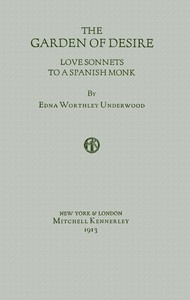
The garden of desire : Love sonnets to a Spanish monk by Edna Worthley Underwood
Let's set the scene: 16th century Spain. Next to a silent, austere monastery lives Isabel, a young woman whose spirit is as bright as the flowers in her family's garden. Separating her world from the monks' is an old stone wall. In the monastery is Brother Luis, a man devoted to God, living a life of quiet contemplation and strict rules.
The Story
This isn't a plot of grand adventures or sneaky meetings. The story unfolds through a series of love sonnets. Isabel, drawn to the mystery of the cloistered life and specifically to the presence of Brother Luis, begins slipping poems through a crack in that garden wall. He, in turn, responds with his own. Their entire relationship exists in these exchanged verses. They explore everything—the beauty of the natural world Isabel describes, the stark peace of Luis's cell, their shared faith, and the slow, undeniable awakening of a deep, spiritual love. The conflict is internal and immense. Luis wrestles with his vows and his devotion to God, wondering if this human connection is a sin or a different kind of grace. Isabel grapples with loving a man who can never be hers in any conventional way. The wall between them is both real and a powerful symbol of the barriers they face.
Why You Should Read It
I picked this up expecting a dusty historical romance, but it's so much more intimate. Underwood gives us front-row seats to two minds in quiet crisis. The sonnets are surprisingly accessible—they feel like raw, private thoughts rather than stiff old poetry. What got me was the intensity of restraint. The fact that these two characters build a profound bond without ever truly being together makes every word between them electric. It's a masterclass in showing how powerful what is unsaid and undone can be. It makes you think about the different shapes love can take.
Final Verdict
This book is perfect for anyone who loves character-driven stories where the biggest battles happen inside someone's soul. If you're into historical fiction that feels immediate and emotional, or if you enjoy poetry that tells a clear, gripping story, you'll fall into this world. It's a short, potent read for a quiet afternoon—one that lingers long after you close the last page. Just be ready for a beautiful, melancholic ache.
You are viewing a work that belongs to the global public domain. You can copy, modify, and distribute it freely.
Michael Harris
6 months agoExactly what I was looking for, thanks!
Elizabeth Rodriguez
8 months agoAfter a thorough walkthrough of the table of contents, the author’s unique perspective adds a fresh layer to the discussion. This adds significant depth to my understanding of the field.
Richard Gonzalez
6 months agoI found the author's tone to be very professional yet accessible, the concise summaries at the end of each section are a lifesaver. I’ll definitely be revisiting some of these chapters again soon.
Richard Perez
2 months agoIt took me a while to process the complex ideas here, but the clarity of the writing makes even the most dense sections readable. The price-to-value ratio here is simply unbeatable.







Elizabeth Martin
3 weeks agoInitially, I was looking for a specific answer, but the logic behind each conclusion is easy to follow and verify. The price-to-value ratio here is simply unbeatable.