
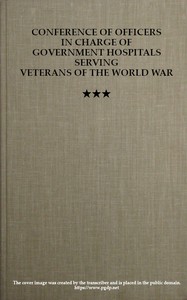
Conference of Officers in Charge of Government Hospitals Serving Veterans of…
Let's be clear from the start: this is not a traditional novel. There are no main characters in the usual sense, no sweeping plot arcs. The 'story' is the meeting itself. The book presents itself as the compiled transcripts, reports, and administrative documents from a gathering of the people running government hospitals for veterans. We read budget proposals, discussions about supply shortages, debates over treatment protocols, and staffing reports.
The Story
The narrative unfolds through these dry documents. You start by just absorbing the facts: bed counts, medication lists, committee structures. But as you read, patterns emerge. Certain issues keep getting brought up only to be tabled. Specific questions from some officers get vague, deflective answers from others. References are made to 'past incidents' or 'ongoing reviews' that are never fully explained. The conflict isn't a shouting match; it's a bureaucratic cold war fought with carefully worded memos and evasive meeting minutes. The central question the book slowly builds is: What is the real state of care for these veterans, and why does the official record feel so incomplete?
Why You Should Read It
This book got under my skin. Its power is in what it doesn't show you. You become a detective, reading between the lines of every 'for your consideration' and 'pending further review.' The 'characters' are these faceless officers, but you start to imagine their frustrations, their cover-ups, or perhaps their genuine helplessness within a broken system. It’s a masterclass in atmosphere. The boredom of bureaucracy becomes tense and eerie. It makes you think deeply about how truth gets buried not in dramatic lies, but in mundane paperwork and procedural delays.
Final Verdict
This is a niche, challenging, but unforgettable read. It's perfect for readers who love unconventional narratives, historical mystery, or stories about systems and institutions. If you enjoyed the creeping dread of Kafka or the procedural puzzle of a book like 'House of Leaves,' but in a stark, realistic setting, you'll find a lot to chew on here. It’s not a book you race through; it’s one you sit with, piecing together the haunting story it refuses to tell outright. A quiet, brilliant puzzle.
This work has been identified as being free of known copyright restrictions. It is available for public use and education.
Margaret White
1 year agoAs a professional in this niche, the nuanced approach to the central theme was better than I expected. I'll be citing this in my upcoming project.
Mary Brown
1 year agoIf you're tired of surface-level information, the data points used to support the main thesis are quite robust. This adds significant depth to my understanding of the field.
Christopher White
10 months agoI was skeptical about the depth of this book at first, but the case studies and practical examples provided add immense value. It’s hard to find this much value in a single source these days.
Linda Lopez
2 years agoIt effectively synthesizes complex ideas into a coherent whole.
Mary Thompson
2 years agoIt’s rare to find such a well-structured narrative nowadays, the case studies and practical examples provided add immense value. It cleared up a lot of the confusion I had previously.