
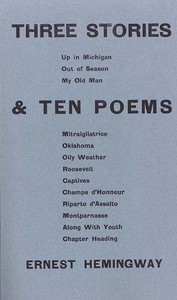
Three Stories & Ten Poems by Ernest Hemingway
Let's be clear: this isn't a novel. Three Stories & Ten Poems is exactly what it says on the tin. Published in 1923 in a tiny run in Paris, it's Hemingway's literary debut, a slim volume that feels more like a collection of sketches and whispers than a finished statement.
The Story
There isn't one single plot. The three stories are brief, brutal snapshots. 'Up in Michigan' is an uncomfortable, startlingly frank story about a romantic encounter that feels more like a violation. 'Out of Season' follows a man and his wife on a frustrating fishing trip, where the real catch is their crumbling marriage. 'My Old Man' gives us a young boy's view of his jockey father's shady world. The ten poems scattered between them are even more fragmented—impressions of war, love, Parisian streets, and loneliness. They don't rhyme neatly; they feel urgent and unpolished.
Why You Should Read It
You read this not for a satisfying, wrapped-up story, but to witness the birth of a style. This is where Hemingway's famous 'iceberg theory' is learning to swim. He's cutting away every unnecessary word, leaving only the bare, hard facts on the page. The emotion isn't described; it's in the silence between the sentences, in what's painfully left unsaid. Reading this feels like looking over the shoulder of a genius who doesn't yet know he's a genius. There's an incredible energy here—the thrill of someone discovering the power of his own voice. You see his obsessions forming: war, masculinity, loss, and the quiet spaces where people fail to connect.
Final Verdict
This is a must-read for any Hemingway fan who wants to understand his origins, and a perfect, bite-sized entry point for anyone who's been intimidated by his bigger novels. It's for readers who love seeing the workshop floor, the sawdust and the early drafts. It's for people who appreciate short, powerful prose that leaves a bruise. Don't expect the epic scope of For Whom the Bell Tolls. Come expecting a literary shot of espresso—strong, bitter, and incredibly potent. In under an hour, you'll have met the young man who would change American writing forever.
This digital edition is based on a public domain text. It is available for public use and education.
Sarah Thomas
4 months agoThought-provoking and well-organized content.
James Jones
8 months agoImpressive quality for a digital edition.
Elizabeth Martinez
1 year agoIt’s refreshing to see such a high standard of digital publishing.
Elizabeth Harris
3 months agoInitially, I was looking for a specific answer, but the author doesn't just scratch the surface but goes into meaningful detail. Top-tier content that deserves more recognition.

Christopher Martin
1 year agoThe author provides a very nuanced critique of current methodologies.