
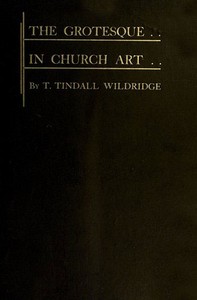
The Grotesque in Church Art by T. Tindall Wildridge
Let's be honest, most books about church architecture talk about soaring arches, beautiful stained glass, and serene sculptures. T. Tindall Wildridge's The Grotesque in Church Art is not that book. Instead, it goes straight for the weird stuff everyone notices but rarely gets explained.
The Story
There isn't a plot in the traditional sense, but there is a compelling quest. Wildridge, writing over a century ago, takes us on a tour of medieval churches across England and Europe. His mission is to catalog and, more importantly, explain the strange carvings found there—the gargoyles, the mischievous 'hobgoblins', the animals behaving badly, and the distorted human faces. He systematically shows these aren't random. He connects them to medieval fables, folklore, and even the sermons of the time. The 'story' is his argument against the common belief that these were just pagan symbols sneaked in by stonecarvers. Instead, he makes the case they were approved, Christian teaching tools in stone, used to illustrate vice, warn against sin, and sometimes just to add a note of familiar, earthy humor to a holy space.
Why You Should Read It
This book completely changed how I look at old churches. Before, I saw the grotesques as separate, almost rebellious, elements. Wildridge convinced me they are part of the whole. His writing has this enthusiastic, slightly old-fashioned charm—you can tell he's delighted by his subject. He isn't just listing monsters; he's trying to get inside the medieval mind. The best parts are when he links a specific carving, like a fox preaching to geese, to a popular story used by priests to criticize corrupt clergy. It turns silent stone into a snapshot of medieval popular culture. It shows a time when faith could encompass laughter, satire, and a blunt acknowledgment of life's dark and silly sides, all within the walls of a church.
Final Verdict
Perfect for history buffs, architecture lovers, or anyone with a curiosity about the Middle Ages who wants to go beyond kings and battles. It's also great for travelers who tour cathedrals; it'll make your next visit ten times more interesting. A word of caution: it's an older book, so the language is a bit formal in places, and some of his theories might be debated by modern scholars. But that doesn't matter. Its core idea—that our ancestors communicated complex ideas through art we now find strange—is powerful and enduring. Read it, and you'll never see a gargoyle as just a rainspout again.
This text is dedicated to the public domain. You are welcome to share this with anyone.
Elizabeth Rodriguez
3 months agoI decided to give this a try based on a colleague's recommendation, the formatting on mobile devices is surprisingly crisp and clear. If you want to master this topic, start right here.
Jennifer Hernandez
10 months agoHaving explored several resources on this, I find that the objective evaluation of the pros and cons is very refreshing. It’s a comprehensive resource that doesn't feel bloated.
Joseph Garcia
10 months agoI didn't expect much, but the emotional weight of the story is balanced perfectly. Worth every second.
Anthony Davis
4 months agoFrom the very first page, the clarity of the writing makes this accessible. Worth every second.
Paul Anderson
5 months agoAfter a thorough walkthrough of the table of contents, the narrative arc keeps the reader engaged while delivering factual content. Highly recommended for those seeking credible information.