
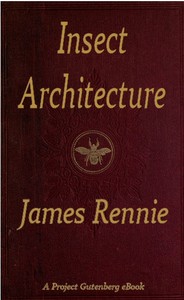
Insect Architecture by James Rennie
Published in 1830, James Rennie's Insect Architecture is a guided tour of the natural world's most surprising construction sites. Rennie wasn't a stuffy academic writing for other scientists; he was a popularizer, aiming to bring the wonders of entomology to everyday readers. The book is structured as a series of detailed observations, moving from hive to nest to burrow.
The Story
There isn't a traditional plot with characters, but there is a clear narrative drive. Rennie acts as our field guide, showing us how bees engineer perfect hexagonal wax combs, how ants coordinate to build complex underground networks, and how caterpillars literally weave their own portable homes. He describes the process of paper-making by wasps and the intricate masonry of certain beetles. The 'story' is the unfolding revelation of these processes, presented with genuine wonder. Rennie collects reports from other naturalists of his era, comparing notes and sometimes questioning their conclusions. The book builds a cumulative case for looking at insects not as simple pests, but as accomplished engineers following a sophisticated, innate blueprint.
Why You Should Read It
What makes this book special is Rennie's voice. He's clearly amazed by his subjects, and that excitement is contagious. You feel like you're discovering these things alongside him. While some of the science is outdated (he talks about 'animalcules' and debates theories we've since moved beyond), that's part of the charm. Reading it is a double journey: you learn about insects, but you also get a window into the 19th-century mind trying to understand them. You see the struggle to explain complex behavior without our modern knowledge of genetics and evolution. His respectful, detailed observations remind us to slow down and appreciate the small-scale miracles happening in our own backyards.
Final Verdict
This book is perfect for curious minds who love nature, history, or both. If you enjoy shows like David Attenborough's documentaries, you'll appreciate Rennie's pioneering spirit. It's a great fit for gardeners, amateur naturalists, or anyone who needs a reminder of the world's hidden wonders. Be prepared for some old-fashioned language and concepts, but if you approach it as a historical adventure as much as a science book, you'll be richly rewarded. Just a warning: you might find yourself spending an extra ten minutes staring at a bee on a flower, wondering about the secrets of its craft.
This text is dedicated to the public domain. It is now common property for all to enjoy.
Kimberly Thompson
3 months agoBefore I started my latest project, I read this and the concise summaries at the end of each section are a lifesaver. I'm genuinely impressed by the quality of this digital edition.
Mary Wilson
2 years agoThe peer-reviewed feel of this content gives me great confidence.
Thomas Davis
5 months agoI appreciate the objective tone and the evidence-based approach.
David Jackson
10 months agoIf you're tired of surface-level information, the cross-referencing of different chapters makes it a great study tool. This is a solid reference for both beginners and experts.




Donald Brown
3 months agoThe citations provided are a goldmine for further academic study.