
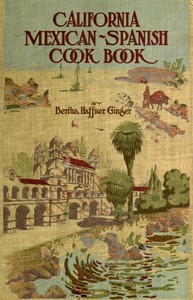
California Mexican-Spanish Cook Book: Selected Mexican and Spanish Recipes
Let's be clear from the start: this isn't a modern cookbook you'd pull off the shelf to make dinner tonight. Published in 1914, Bertha Haffner-Ginger's California Mexican-Spanish Cook Book is a historical document. It's a collection of recipes assembled by a home economics instructor for her students in the Los Angeles area. The 'story' here isn't a narrative with characters, but the story of an idea: how a particular cuisine was translated and taught at a specific point in time.
The Story
The book is a straightforward manual. Haffner-Ginger presents a series of recipes she labels as Mexican and Spanish. You'll find directions for making tamales, enchiladas, and Spanish rice alongside dishes like 'Spanish Beef Steak' and various baked goods. There are no personal anecdotes or travel stories. The prose is instructional and concise, reflecting her role as a teacher. The context is everything. California in 1914 was experiencing significant demographic shifts, and this book represents one educator's attempt to systematize and share culinary practices from these cultures with a primarily Anglo student body. The plot, so to speak, is in the subtext—the choices made in curation and instruction.
Why You Should Read It
I find this book utterly compelling as a food history enthusiast. It's a primary source. Reading it, you get a direct look at what a well-meaning, early 20th-century American teacher considered the essential dishes of 'Mexican-Spanish' cooking. The language and framing are products of their time, which is precisely what makes it insightful. You see which ingredients were accessible (or which substitutes were suggested), how techniques were simplified for a home kitchen, and how flavors were described. It's not about replicating the recipes perfectly; it's about understanding the lens through which this cuisine was viewed. It sparks curiosity about what was happening in the actual Mexican and Spanish communities' kitchens just outside the classroom window.
Final Verdict
This is a niche but wonderful read for a specific crowd. It's perfect for food history nerds, culinary professionals curious about recipe evolution, or anyone fascinated by California's cultural past. If you're looking for an authentic, step-by-step guide to regional Mexican cooking, look elsewhere. But if you're the kind of person who loves old manuals, appreciates primary sources, and enjoys thinking about how food traditions are passed on (and sometimes altered), this free, public-domain book is a treasure trove. It's a quiet conversation with the past, and sometimes those are the most interesting ones to have.
No rights are reserved for this publication. Thank you for supporting open literature.
William Smith
10 months agoThe digital formatting makes it very easy to navigate.





Christopher Harris
4 months agoA must-have for graduate-level students in this discipline.